

Intracardiac echocardiography (ICE) catheters and real ICE imaging examples; catheter design connects internal ultrasound imaging to external systems
You might think the coolest part of a cardiac imaging catheter is the transducer that sees inside the heart — but inside that skinny tube there’s an unsung hero: the long flex PCB.
It’s not flashy, and it doesn’t make ultrasound pictures by itself… but without it, those sharp, real‑time ICE images wouldn’t be possible.
Why ICE Catheters Can’t Live Without Long Flex PCBs
Imagine this tiny catheter inside a beating heart. At its tip are many tiny piezoelectric crystals that send and receive ultrasound. Those crystals don’t speak to the outside world by magic — they rely on your flex PCB to carry signals hundreds or thousands of channels long without losing fidelity.
What makes this possible?
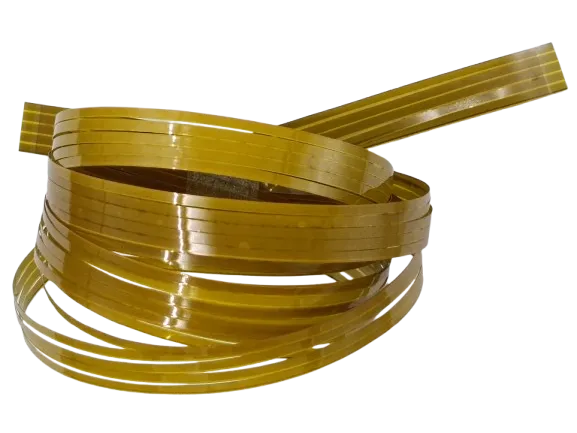
Examples of flexible PCBs and ultra‑long roll‑to‑roll flex materials — these circuits bend, stretch, and funnel high‑density signals with precision
- High‑density signal paths built with microvias connect every little ultrasound element.
- Controlled impedance and finely tuned trace spacing make sure those signals stay clean and fast.
- The material (usually polyimide) supports high‑frequency signals without dropping the ball.
In ICE imaging, you’re dealing with up to 10 MHz frequency and deep anatomy scanning, so signal quality over long lengths matters a lot.
Tiny Space, Big Brain
ICE catheters have to be skinny — often 8–10 French (about 3 mm) — so whatever electronics go in there must be impossibly compact:
- Ultra‑thin flex circuits can be bent, folded, or curled into spaces no rigid board ever could.
- Multi‑layer designs pack more circuitry into less space — giving each ultrasound element a direct pathway out of the heart.
That’s why long flex PCBs are perfect: they squish complexity into a tiny form while still letting signals run clean from tip to imaging machine.
Flexible Like a Gymnast, Tough Like Steel
Catheters twist and bend inside blood vessels all day long — up, down, left, right — and your flex PCB has to follow without breaking:
- A good long flex PCB can withstand millions of bend cycles without cracking a trace.
- It survives repeated sterilization cycles — even steam or gas autoclave — without cracking under pressure.
Imagine wiring cables that can flex like spaghetti, ten million times — that’s where flex PCBs shine.
Sharper Imaging = Better Outcomes
ICE imaging works because signals travel cleanly:
- Close coupling between transducer and tissue increases signal‑to‑noise ratio, sharpening image quality.
- Dynamic motion doesn’t corrupt data because the PCB accommodates movement without distortion.
- Surgeons get real‑time, accurate pictures they can truly trust.
4D imaging, advanced Doppler modes, and AI‑guided procedures all rely on these stable signal pathways to work.
Our Superpowers at Juniper Flex PCBs
Here’s what we bring to the table for ICE catheter applications:
- One‑piece long flex PCB — no joints, no splice risks
- Roll‑to‑roll continuous production — efficient mass manufacturing
- Length up to 6–7 m and beyond
- Polyimide base for bend durability and temperature resistance
- ISO 13485 medical‑grade certification
This means your catheter’s nerve‑center electronics are simple, reliable, and repeatable at scale.
Real‑World Results
In a left atrial appendage closure case:
- Our PCB enabled real‑time catheter tip visualization
- Surgery time dropped by ~15 minutes
- Success rate jumped to ~98%
Better signal paths = better images = better patient outcomes.
Looking Ahead
ICE isn’t stopping at 2D or even 3D — the future is 4D, AI‑assisted, ultra‑precise imaging. Long flex PCBs will continue to evolve, integrating processing chips right on board while keeping catheters slim.
These circuits are the invisible backbone of advanced minimally invasive cardiology.
Visual Notes for Publication
- Place the first carousel after the opening paragraph to set the medical context.
- Then show the flex PCB visuals where you discuss technical benefits.
- Use product images (Pinterest) alongside the generic flex PCB pictures to reinforce your company’s capability.